Hybrid v Utility Iron v Long Iron: Which Should You Carry?
Lots of options at the top of the bag, we dissect what you should carry.

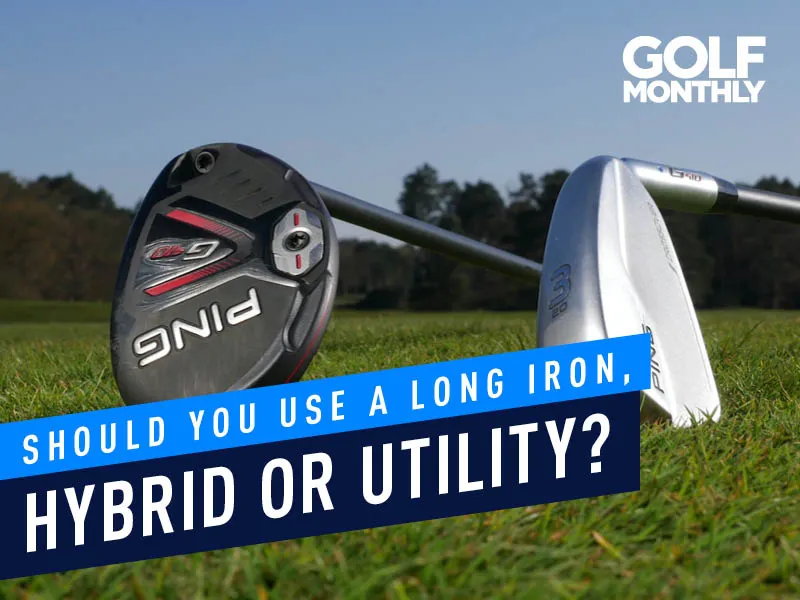
Lots of options at the top of the bag, we dissect what you should carry.
Hybrid v Utility Iron v Long Iron: Which Should You Carry?
Golfers now have three distinct options at the top end of the bag: hybrids, long irons or utility clubs. Of course, you can mix and match but it is worth taking the time to ask yourself - Hybrid v Utility Iron v Long Iron: Which should you carry?
The answer lies in two key factors: your swing speed and your launch angle. To help highlight how it works, we have conducted a test. I hit all three clubs at my normal clubhead speed and gathered the data. Then I hit all three at half speed (a speed that is much more applicable to the average golfer) to compare how the data changed. The results tell an interesting and important story.
When you should switch from irons into hybrids?
Hybrid
I was using a PING G400 3-hybrid with a stock stiff shaft in it. At full speed (97mph clubhead speed), I was able to carry the ball 202 yards from a launch angle of 16˚. Perhaps more importantly, the decent angle was great – 44˚ gives fantastic control.

With a 77mph clubhead speed the distance drops to 140 yards carry and the decent angle is 33˚. Whilst there is a drop off in each of the key numbers, the performance (flight and carry) remains pretty good.

Long Iron
Using my set 3-iron (a TaylorMade Psi), my full speed numbers are very playable. From 94mph of clubhead speed I was getting 196 yards of carry and the decent angle was still quite high at 43˚. This means that at my clubhead speed, the long iron performance stacks up well and is certainly playable.

However, as I dropped the clubhead speed down to 75mph, the performance fell away dramatically. Just 112 yards of carry and a decent angle of 25˚ makes the 3-iron completely unplayable at this speed.

Utility Iron
The utility iron I used was the PING G400 Crossover. As with the hybrid the shaft was the stock stiff version but it is graphite so is lighter than the stiff steel shaft in the long iron. Interestingly the carry distance was the same as the hybrid and the descent angle was even better at 45˚. I was actually surprised by how easy the Crossover was to hit and as the numbers show, the performance was excellent.

At the lower speed (74 mph) the carry was 18 yards longer than the long iron but significantly shorter than the hybrid. This is down to the wider sole and the lighter graphite shaft. Again, the descent angle is good at 31˚.

Hybrid v Utility Iron v Long Iron: Which should you carry?
This test was designed to act purely as an illustration. There is no doubt I would have been able to gain more performance from all three clubs at the slower speed with the perfect shaft. However, the point remains valid. To hit the smaller headed long iron, you need to generate a certain amount of clubhead speed. If you can’t do that, you really shouldn’t bother carrying one. Long iron aside, your choice is simple. In my opinion, the hybrid is a little more versatile as you can use it well from light rough and around the greens. However, there are plenty of golfers out there who prefer an iron-like profile. In which case, the utility iron is a great option.
Don't forget to follow Golf Monthly on Facebook, Twitter and Instagram.
